
The Evolution of LED Lighting at JIEMline | Technology
Published on July 7, 2026
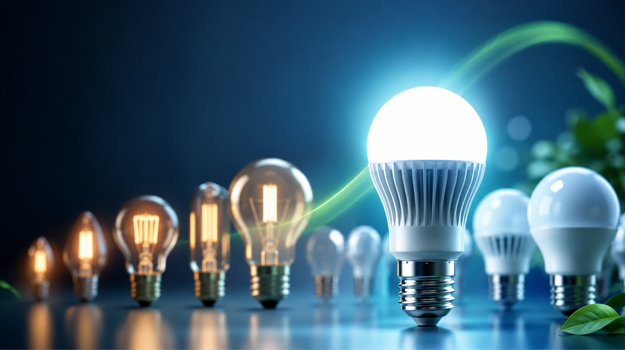
A look at its history, present and future
LED lighting has come a long way since its humble beginnings, becoming one of the most popular and efficient lighting technologies in the world. Its evolution has been driven by the growing demand for sustainable energy solutions and constant advances in semiconductor technology. At JIEMline, we follow this evolution closely so we can always bring you the most efficient and up-to-date LED solutions on the market. Today, LED lighting has not only transformed the way we light our homes and cities, but has also influenced sectors such as agriculture, transportation, and entertainment. Below, we explore how this technology has evolved and its impact today.
Early developments: From the lab to the home
The first LEDs (Light Emitting Diodes) were developed in the 1960s by scientist Nick Holonyak, who created the first visible LED. However, in its early years, LEDs could only emit light in colors like red and green, limiting their use to signaling applications in electronic devices. During the 70s and 80s, advances in semiconductor materials allowed the creation of LEDs in different colors, including blue, paving the way for white light.
The real revolution began in the 1990s, when Shuji Nakamura developed the high-efficiency blue LED, enabling the color combination that resulted in white light. This marked a key milestone, as white light was essential to replace incandescent and fluorescent bulbs in home and industrial applications.
The rise of energy efficiency and sustainability
One of the biggest advantages of LED lighting is its high energy efficiency. Compared to incandescent bulbs, LEDs use 75% to 80% less energy, significantly reducing electricity bills and carbon emissions. This efficiency has made LEDs an ideal choice for governments and businesses seeking more sustainable lighting solutions for buildings, streets, and public spaces.
In addition, LEDs have a much longer lifespan than traditional lighting technologies. While an incandescent bulb can last around 1,000 hours, an LED can run for up to 50,000 hours or more. This not only reduces how often replacements are needed, but also cuts down on waste.
Recent innovations: Smart, adaptable lighting
The evolution of LEDs hasn't only focused on improving energy efficiency, but also on adding intelligence to lighting. Today, many LED lighting systems are integrated with "smart" technology, allowing users to control lighting through mobile devices or virtual assistants. LEDs can be adjusted in brightness and color, providing a fully customizable lighting experience for any moment. This is especially useful in smart homes, offices, and commercial spaces, where lighting plays a key role in creating atmosphere.
In addition, sensor-based adaptive lighting technology has made LEDs even more energy efficient. For example, street and office LED lights can automatically adjust based on ambient light or occupancy, further reducing energy consumption.
Applications beyond conventional lighting
Today, LEDs aren't just used for general lighting, but have also found applications in innovative sectors. In agriculture, for example, LED systems are used to optimize plant growth in vertical farms and controlled environments. Thanks to their ability to emit light at different wavelengths, LEDs can be adjusted to provide the exact amount of light a plant needs for more efficient photosynthesis.
In healthcare, LED technology has been used in skin phototherapy treatments and to improve circadian rhythms in environments with limited natural light, such as hospitals or windowless workplaces.
The future of LED lighting
LED technology continues to evolve and promises to become even more efficient in the future. Current research is focused on further improving luminous efficacy (the amount of light an LED can produce per watt of energy) and reducing production costs. In addition, OLEDs (Organic Light Emitting Diodes) are starting to gain ground, offering softer, more flexible light that can be applied to curved or transparent surfaces, further expanding design possibilities.
In short, LED lighting has revolutionized the world of lighting in recent decades, becoming a key technology for a more sustainable future. Its efficiency, durability, and adaptability have transformed sectors as diverse as architecture, agriculture, and healthcare, and its growth potential remains enormous. With continuous technological innovation, LEDs are ready to light up the future in a brighter, greener way than ever.
At JIEMline, we keep a close eye on this evolution to bring you the most efficient and up-to-date LED solutions, for your home or your business. If you're thinking about upgrading your lighting, take a look at our catalog and find the option that best fits your project.